
Key Takeaways
- Data center decommissioning in a circular economy prioritizes reuse, refurbishment and responsible recycling to reduce waste and recover value from retired hardware.
- The circular hierarchy of reuse, refurbish, harvest, recycle and dispose delivers up to 57 times greater CO2 savings than recycling alone by preserving embodied carbon.
- Structured circular programs recover 40–70% of original equipment costs, while rushed disposal often recovers only 15–25% of potential value.
- Certified ITAD partners with R2v3, e-Stewards and NAID AAA credentials, on-site data destruction and transparent reporting support compliance and value recovery.
- Full Circle Electronics delivers certified, reuse-first decommissioning services that maximize financial returns and ESG outcomes. Start planning a circular decommissioning project with Full Circle Electronics.
Defining Data Center Decommissioning In A Circular Economy
The linear model follows a simple path: buy equipment, run it until it is no longer needed, then dispose of it. This approach converts retained asset value into a disposal cost and sends hardware into the global e-waste stream. The UN Global E-Waste Monitor 2024 recorded 62 million tonnes of e-waste generated in 2022, with only 22.3% formally collected and recycled. The remainder represents lost material value, environmental harm and unreported Scope 3 liability.
The circular economy applies three core principles to data centers: design out waste, keep assets in use at their highest value and regenerate natural systems by recovering materials. Applied to decommissioning, this approach evaluates every asset for reuse before recycling and treats recycling as the final option.

The shift from simple recycling to a reuse-first hierarchy matters because the environmental and financial gap between tiers is large. Lifecycle assessment data from the Circular Computing Foundation shows that refurbishing and reselling servers prevents approximately 316 kg of CO2 emissions per unit, compared to recycling which saves only 5.5 kg per unit. Avoided manufacturing emissions drive this 57-fold difference.
The Circular Economy Hierarchy For Data Centers
The circular hierarchy for data center assets runs in descending order of value preserved: reuse, refurbish, harvest components, recycle and responsible disposal. Each tier represents a distinct trade-off between value recovery and environmental impact.
Reuse means redeploying servers, networking equipment or storage arrays internally or through resale. Reuse preserves the most embodied carbon because the complete system stays in service. Its manufacturing emissions are amortized across more useful work. Functional enterprise servers less than five years old can retain meaningful residual value on the secondary market, which makes reuse the highest-return disposition path.

Refurbishment involves repairing, cleaning, testing and recertifying equipment for a second owner. Refurbishment saves up to approximately 85% of the energy required to manufacture new equipment. A peer-reviewed case study found a remanufactured server scored 858.3 kg CO2-eq on climate-change impact versus 3,077.2 kg CO2-eq for a new-build scenario. That result represents a saving of more than 2,200 kg CO2-eq per unit.

Component harvesting recovers working parts such as DIMMs, NICs, drives and power supplies for spares, repair or another build. This tier recovers less value than whole-asset reuse but substantially more than material recycling. Microsoft reused more than 3.2 million components in 2024 through its Circular Centers program, which demonstrates component harvesting at scale.
Recycling recovers raw materials, principally copper, aluminum, gold and rare earth elements, from non-functional equipment. It becomes the correct route when reuse and repair are no longer viable, although it destroys the most embodied value. Formal e-waste recycling avoided 93 million tonnes of CO2-equivalent emissions in 2022, including avoided metal-mining emissions. Responsible recycling still delivers meaningful environmental benefit over landfill disposal.

Responsible disposal applies to non-functional or sensitive equipment that cannot be reused or recycled safely. Certified destruction protects data security and regulatory compliance while preventing hazardous materials from entering uncontrolled waste streams.
Full Circle Electronics applies this hierarchy through IT asset disposition, asset remarketing, component harvesting and certified scrap recycling services. Each asset routes to its highest-value outcome.
How To Decommission A Data Center: Step-By-Step Guide
A circular decommissioning process follows a structured sequence that prioritizes value recovery and compliance at every stage. Enterprise projects run from planning through final disposition, with physical removal spanning weeks to months.
- Conduct a comprehensive asset audit and inventory. Walk every rack and capture make, model, serial number, asset tag, rack location and data classification for each asset. This inventory establishes the baseline. Reconciling the physical inventory against the CMDB then exposes gaps that can become missed value or compliance risk. Full Circle Electronics performs serialized asset reconciliation at the point of service.
- Develop a decommissioning plan that prioritizes reuse and refurbishment. Classify every asset into a disposition category such as relocate, remarket, harvest, recycle or destroy. Early engagement with an ITAD partner during planning aligns timelines, logistics and value recovery targets before execution begins.
- Ensure secure data destruction following NIST 800-88 or equivalent standards. Match the sanitization method to the media type and data classification. Full Circle Electronics performs on-site NIST-compliant wiping and physical shredding by background-checked professionals and issues per-device certificates of destruction.
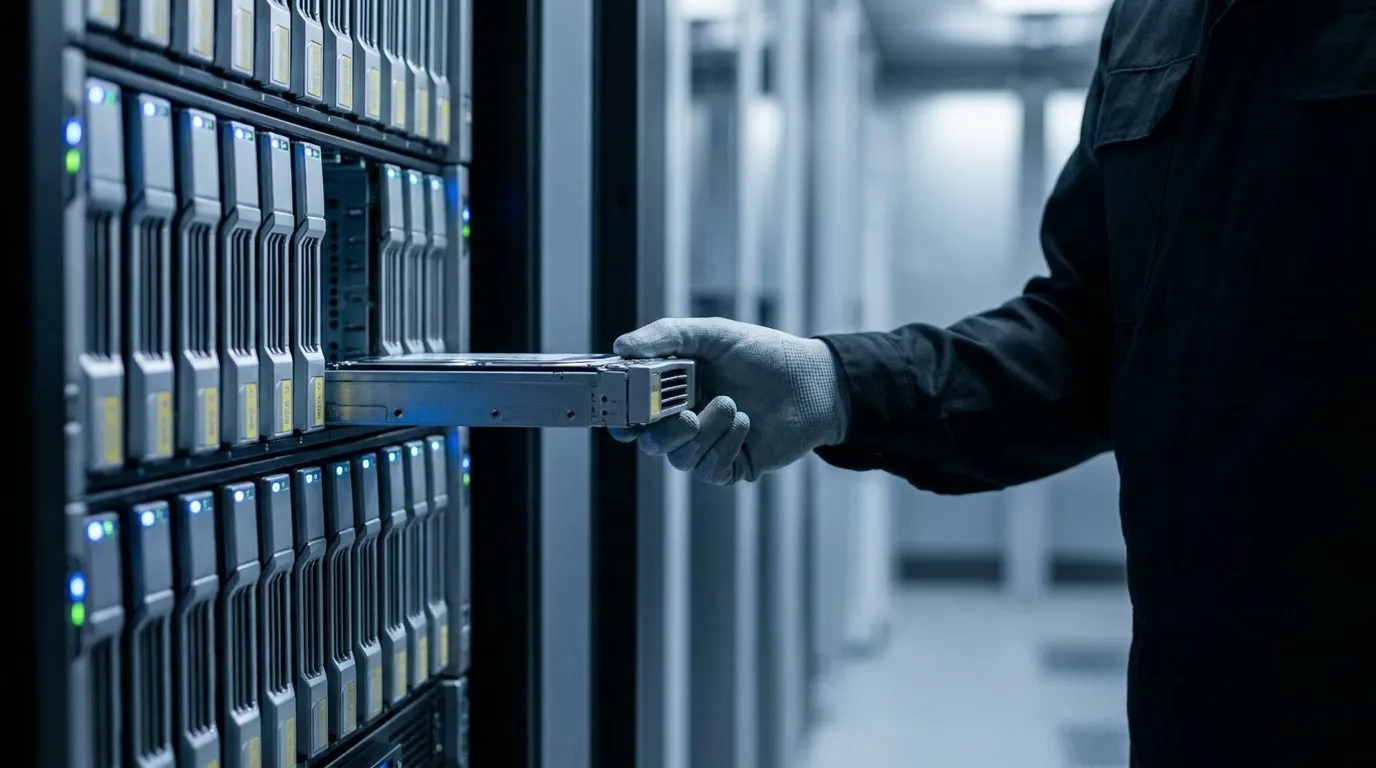
- De-rack, de-stack and remove assets with minimal disruption. Decommission rack by rack and scan each asset at the moment of removal. This approach maintains chain-of-custody accuracy. Full Circle Electronics provides white-glove de-racking and de-stacking services, handling physical labor and serialized tracking so internal teams remain focused on core operations.
- Evaluate assets for reuse, refurbishment or resale. Test and grade equipment after sanitization to determine the best disposition path. Full Circle Electronics operates transparent revenue-sharing models so clients see the value recovered from each asset category.
- Recycle non-functional equipment through certified recyclers. Route equipment that cannot be reused to R2v3 or e-Stewards certified processors. Verify that certifications cover the specific facility and processes involved. Full Circle Electronics holds R2v3, e-Stewards and ISO 14001 certifications, with coverage varying by facility.
- Restore the facility and document outcomes for ESG reporting. The closeout package should include a complete asset disposition report, per-serial-number certificates of destruction, chain-of-custody logs, environmental compliance certificates and a value recovery report. Full Circle Electronics provides audit-ready reporting and a 24/7 customer portal for tracking all metrics.
Real-World Circular Decommissioning Results
Major data center operators have demonstrated that circular decommissioning is operationally achievable at scale.
Google’s Reverse Supply Chain program harvested approximately 8.8 million components from decommissioned hardware for reuse or resale in 2024, including over 3 million hard drives. Forty-four percent of components used for Google-managed server builds, maintenance and upgrades came from reused inventory in 2024, and 84% of operational waste was diverted from disposal across Google-owned and -operated data centers.
Microsoft’s Circular Centers program reused or recycled 92% of decommissioned cloud hardware in 2024, exceeding its 90% goal one year ahead of schedule. Reusing those components increased the value Microsoft gets from existing equipment by over 30%. These results show that circular decommissioning delivers financial returns alongside environmental outcomes.
Comparable outcomes extend beyond hyperscalers. A 2023 regional financial services company decommissioning a 5MW colocation facility in Chicago generated $2.8 million in gross asset sales against $680,000 in total project costs, achieving 94.7% diversion from landfills. The project director credited beginning asset evaluation six months before physical decommissioning as the key factor in improving sale prices.
Full Circle Electronics delivers similar circular outcomes through certified processes, white-glove service and transparent reporting across projects of all sizes.
Financial And Environmental Benefits Of Circular Decommissioning
Circular decommissioning generates returns on two dimensions simultaneously: financial value recovery and measurable environmental impact.
On the financial side, organizations following structured decommissioning protocols recover 40–70% of original equipment costs. This approach transforms a compliance obligation into a profit center. Rushed decommissioning projects typically recover only 15–25% of potential asset value compared to planned approaches that achieve 60–75% recovery rates. Full Circle Electronics’ revenue-sharing models and multi-channel remarketing support strong financial returns from retired assets.
On the environmental side, extending the lifecycle of one server by just two years can save up to 1,566 kg CO2e. Hardware-related embodied emissions contribute 20–35% of total data center lifecycle emissions. Embodied carbon accounts for roughly 40% of a data center’s total lifetime carbon footprint. That share is higher for facilities running on renewable energy and lower for fossil-fuel-powered grids. Reuse and refurbishment directly reduce this embodied carbon burden.
These outcomes support ESG goals and can be quantified for stakeholder reporting through metrics like landfill diversion rate, recovered asset value, reuse rate and Scope 3 Category 12 emissions avoided. Full Circle Electronics provides the audit-ready documentation needed to substantiate these figures in ESG disclosures.
Common Challenges And Practical Solutions
Several recurring challenges complicate circular data center decommissioning. Each has a practical and repeatable solution.
Data security risks during asset handling represent the most consequential challenge. On-site data destruction, which wipes or shreds drives before they leave the facility, eliminates transit risk entirely. Full Circle Electronics performs on-site NIST-compliant destruction by vetted professionals and issues per-device certificates for every engagement.
Lack of asset visibility and tracking leads to missed value recovery and compliance gaps. Serialized scanning at the point of removal, reconciled against the CMDB, closes this gap. Full Circle Electronics tracks every asset through a secure real-time online portal available 24/7.
Vendor transparency and certification gaps create downstream liability. Certification applies to a specific facility and defined activities. Procurement teams should confirm the certified location, covered processes and whether subcontractors fall within scope. Full Circle Electronics holds R2v3, e-Stewards, NAID AAA, ISO 9001, ISO 14001 and ISO 45001 certifications and performs destruction in-house, which maintains an unbroken chain of custody.
Logistics complexity for multi-site operations requires a provider with standardized workflows and international reach. Full Circle Electronics operates certified facilities across eight U.S. states plus Mexico and Colombia. This footprint supports multi-site and international decommissioning projects under a single accountable provider.
Checklist And KPIs For Circularity Success
A circular decommissioning project requires defined metrics from the outset. The following checklist covers the essential planning and execution steps.
- Conduct a complete physical asset audit reconciled against the CMDB
- Classify every asset by disposition category such as reuse, refurbish, harvest, recycle or destroy
- Define reuse and diversion targets before physical removal begins
- Select a certified ITAD partner with R2v3, e-Stewards and NAID AAA certifications
- Establish data destruction protocols matched to media type and data classification
- Implement serialized chain-of-custody tracking from removal through final disposition
- Set up tracking and reporting through a real-time portal
- Retain per-device certificates of destruction and recycling for a minimum of seven years
These steps align with a focused set of KPIs that measure circularity success.
- Reuse rate: percentage of assets redeployed or resold
- Recycling rate: percentage of non-reusable assets processed through certified recyclers
- Landfill diversion rate: total weight diverted from landfill as a percentage of total project weight
- Value recovered: gross and net proceeds from remarketing and material recovery
- Data destruction certificates issued: one per data-bearing device
- Scope 3 CO2e avoided: embodied carbon savings from reuse and refurbishment versus replacement
- Regulatory compliance: zero audit findings across HIPAA, PCI-DSS, SOX and applicable e-waste regulations
Full Circle Electronics provides audit-ready reporting and a customer portal that tracks all of these metrics. Clients can demonstrate circularity progress to internal and external stakeholders with confidence.
How To Choose A Certified ITAD Partner For Circular Decommissioning
The ITAD partner selection decision determines whether a decommissioning project achieves circular outcomes or defaults to linear disposal. The following criteria distinguish partners capable of delivering genuine circularity.
- Certifications: R2v3, e-Stewards, NAID AAA, ISO 14001 and ISO 9001 form the baseline. Confirm that certifications cover the specific facility and processes involved.
- Reuse-first approach: The partner should evaluate every asset for reuse and refurbishment before routing to recycling, with remarketing capabilities and transparent revenue-sharing models.
- Secure data destruction: NIST 800-88-compliant wiping and physical shredding, with per-device certificates of destruction and an unbroken chain of custody.
- Transparent reporting: Audit-ready documentation covering asset disposition, value recovered, weight diverted and Scope 3 emissions avoided, accessible through a real-time portal.
- Multi-site and international capabilities: Consistent service execution and reporting across multiple locations under a single accountable provider.
- In-house processing: Partners who perform destruction in-house maintain tighter chain-of-custody control and simpler audit trails.
Full Circle Electronics meets all of these criteria. The company brings more than 20 years of experience and certified facilities across the United States, Mexico and Colombia. Its certification stack includes R2v3, e-Stewards, NAID AAA, ISO 9001, ISO 14001 and ISO 45001. That combination supports circular decommissioning for organizations of any size, from regional data centers to Fortune 1000 enterprises with multi-site footprints.
Request a quote for an upcoming decommissioning project or schedule a consultation.
FAQ
What Is Data Center Decommissioning Circular Economy?
Data center decommissioning circular economy is the process of retiring data center assets such as servers, storage, networking equipment and infrastructure while prioritizing reuse, refurbishment and responsible recycling over disposal. The goal is to minimize waste, recover financial value and reduce the embodied carbon burden of hardware replacement. This approach treats retired equipment as a recoverable asset rather than a disposal cost.
How Does Circular Decommissioning Differ From Traditional Decommissioning?
Traditional decommissioning focuses on removing hardware from service and disposing of it, often defaulting to recycling or landfill without evaluating residual value. Circular decommissioning applies a hierarchy of reuse first, then refurbish, then harvest components, then recycle to maximize value recovery and minimize environmental impact at every stage. Structured circular programs consistently recover a higher percentage of original equipment costs and divert more weight from landfill than unplanned disposal approaches.
What Certifications Should An ITAD Partner Hold?
The strongest ITAD partners hold R2v3 or e-Stewards certification for responsible recycling, NAID AAA certification for data destruction, ISO 14001 for environmental management and ISO 9001 for quality management. NAID AAA is particularly important because it requires unannounced third-party audits covering employee screening, physical security, equipment calibration and chain-of-custody documentation. When evaluating a partner, confirm that certifications apply to the specific facility that will process the assets.
How Can Organizations Ensure Data Security During Decommissioning?
Data security during decommissioning requires matching the sanitization method to the media type and data classification while following NIST SP 800-88 guidelines. Hard drives can be sanitized through overwriting or degaussing. SSDs require firmware-level cryptographic erase or physical destruction due to wear-leveling. Every data-bearing device should receive a per-device certificate of destruction listing the serial number, sanitization method, date, operator and verification result. On-site destruction, performed at the client facility before hardware leaves, eliminates transit risk and serves as the defensible default for regulated data. Choosing a NAID AAA certified partner with background-checked technicians and a documented chain of custody from removal through final disposition provides strong assurance.
How Is Circularity Success Measured In A Decommissioning Project?
Circularity success is measured through KPIs that track both environmental and financial outcomes. Key metrics include the reuse rate, landfill diversion rate, value recovered, data destruction certificates issued per device and Scope 3 CO2e avoided through reuse and refurbishment versus replacement. These metrics can support ESG disclosures under GHG Protocol Scope 3 Categories 5 and 12 and sustainability reports aligned with GRI, SASB and ISSB frameworks. A certified ITAD partner should supply the serialized chain-of-custody documentation and weight-based recycling records needed to substantiate these figures in an audit.
Conclusion And Next Steps
Circular data center decommissioning is achievable and financially sound. The circular economy hierarchy of reuse, refurbish, harvest and recycle provides a clear decision framework for every asset. A structured process, certified partner and transparent reporting infrastructure turn decommissioning into a value-recovery and ESG opportunity.
Evidence from major operators and regional enterprises shows what reuse-first decommissioning achieves at scale. Comparable outcomes become accessible when projects start early, follow a defined hierarchy and work with a certified ITAD partner.
Full Circle Electronics brings more than 20 years of certified ITAD experience, a reuse-first model, white-glove decommissioning services and a footprint spanning the United States, Mexico and Colombia. Its certification stack supports compliance requirements across HIPAA, PCI-DSS, ITAR and GDPR. Audit-ready reporting and a real-time customer portal give IT, sustainability and finance teams the documentation needed to demonstrate circularity outcomes to stakeholders.
The next steps are clear: conduct an internal assessment of upcoming decommissioning needs, define circularity and value recovery targets and engage a certified partner early in the planning process. Starting the asset evaluation process months before physical removal consistently improves both financial recovery and environmental outcomes.
Begin planning a circular decommissioning project with Full Circle Electronics.