
Key Takeaways
-
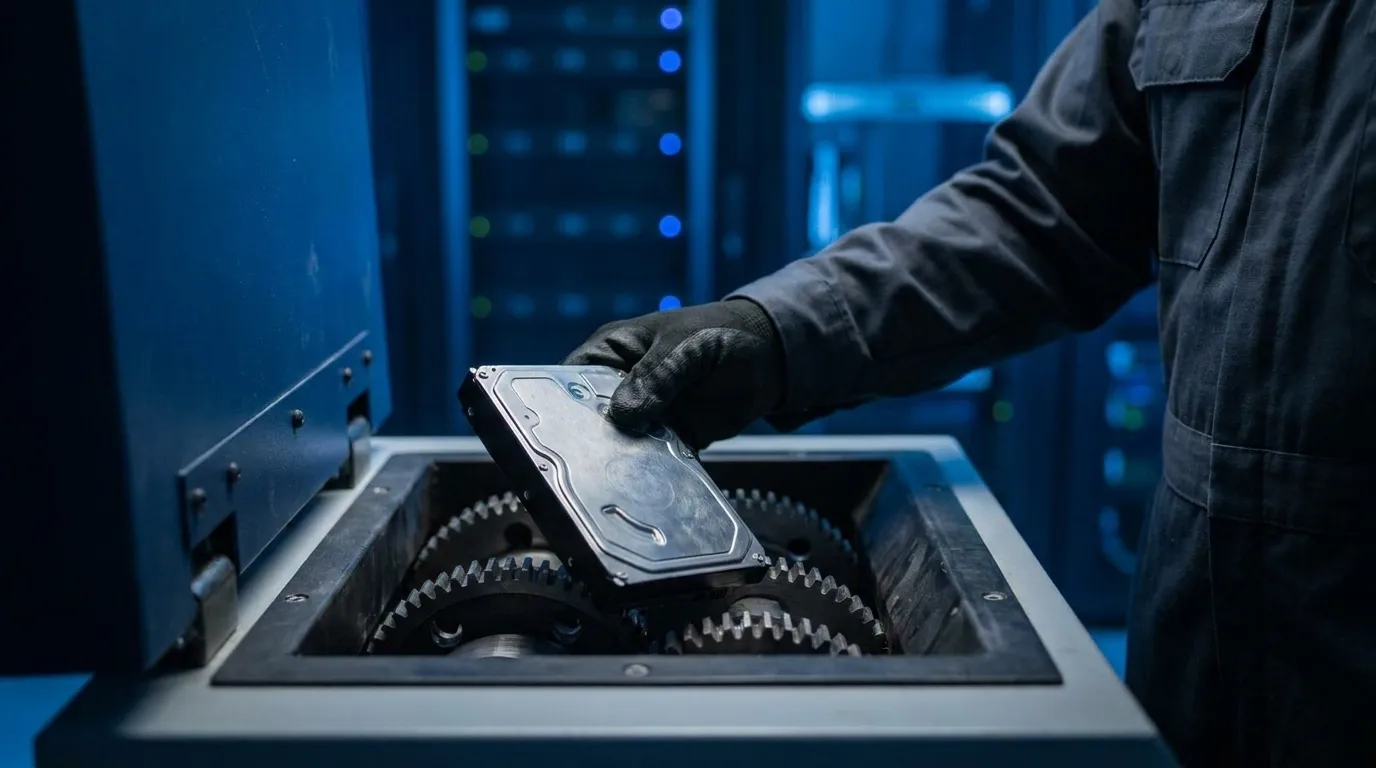
On-site hard drive destruction services bring certified mobile equipment to a facility, remove transit risk and issue immediate Certificates of Destruction.
-
Physical shredding meets NIST 800-88 Destroy standards for HDDs and SSDs. Degaussing and software wiping depend on drive type and regulations.
-
DIY destruction methods fail compliance audits because they produce no serialized documentation, chain-of-custody records or compliant Certificates of Destruction.
-
Provider evaluation should prioritize NAID AAA certification, background-checked technicians, in-house destruction and secure portal reporting for audit-ready records.
-
Full Circle Electronics delivers certified on-site hard drive destruction services with background-checked technicians and in-house shredding across the U.S., Mexico and Colombia.
How On-Site Hard Drive Destruction Services Protect Data
On-site hard drive destruction services move through defined custody checkpoints that create a clear audit trail at every step.

-
Scheduling and Scoping: The organization inventories data-bearing assets, identifies regulatory obligations and selects a destruction method. Full Circle Electronics responds quickly so procurement teams receive timely quotes.
-
Arrival of the Mobile Destruction Unit: A mobile hard drive destruction unit arrives at the facility. On-site shredding removes transit risk because media is destroyed before it leaves the premises.
-
Serialized Inventory and Chain-of-Custody Intake: Technicians log each drive by serial number before destruction. This serialized intake forms the base of the audit trail.
-
Supervised Destruction in the Client’s Presence: Technicians perform physical destruction on-site while authorized personnel observe. Full Circle Electronics completes destruction in-house rather than brokering it to a third party, which maintains a clear chain of custody.
-
Certificate of Destruction and Portal Reporting: A Certificate of Destruction is issued immediately after the event. Clients access certificates, destruction records and real-time reports through a secure customer web portal with CSV export for audits.
On-site hard drive destruction services are available nationally, with Full Circle Electronics facilities in Arizona, Northern and Southern California, Colorado, Florida, Georgia, Illinois and Texas, plus operations in Mexico and Colombia. All employees are background-checked as required by NAID AAA certification.
Confirm service availability for a specific location with a certified specialist.
Choosing a Destruction Method for HDDs and SSDs
Method selection depends on drive type, data sensitivity and whether the media will be reused. Each method maps to a specific outcome under NIST SP 800-88 Rev. 1 and DoD 5220.22-M.
Physical shredding applies to both HDDs and SSDs and meets the NIST 800-88 Destroy level for all device types. Industrial shredders reduce drives to small particles. Shredding is the required method in three cases: drives that will not be reused, data sensitivity that demands maximum assurance and damaged media that cannot be reliably wiped. Regulated industries treat shredding as the default standard.
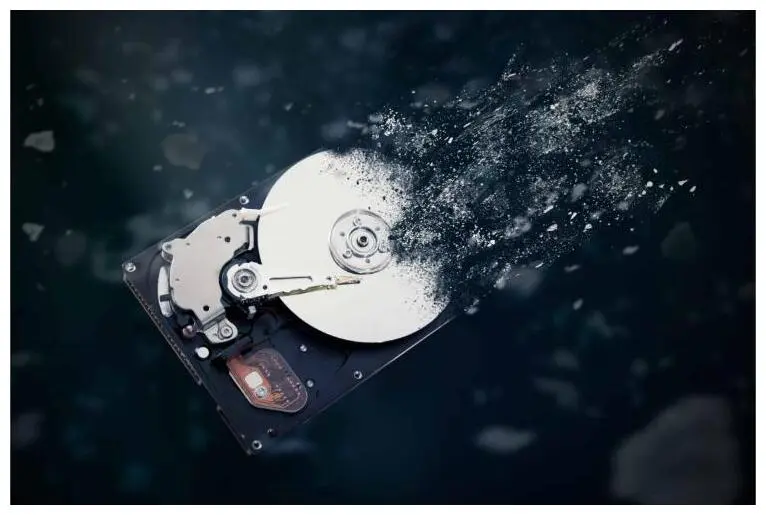
Crushing physically deforms the platters and circuit boards of traditional magnetic hard drives and renders the drive inoperable. For SSDs, crushing alone may leave flash memory chips intact, so it can fall short of complete destruction. Crushing meets the NIST 800-88 Destroy level and fits end-of-life media that will not be remarketed.
Degaussing applies a strong magnetic field to randomize the magnetic domains on HDD platters and meets the NIST 800-88 Purge level for magnetic media. Degaussing has no effect on SSDs because solid-state drives store data as electrical charge in NAND flash cells rather than magnetic patterns. A degaussed SSD can remain fully recoverable. Degaussing also does not apply to optical media or flash drives.
Software-based wiping overwrites addressable sectors with defined patterns. The classic DoD 5220.22-M sequence uses multiple passes followed by a verification read-back. Software wiping can satisfy NIST 800-88 Clear or Purge standards for HDDs in reuse scenarios. It does not suit SSDs because wear leveling and over-provisioning hide cells from host-level overwrite commands, leaving stale remapped blocks recoverable by forensic tools. Physical destruction fits drives that will not be reused or media that is damaged.
Full Circle Electronics follows NIST 800-88 and DoD 5220.22-M standards across its destruction methods and issues certificates of destruction for every engagement.
Discuss the right destruction method for the drive mix with a certified specialist.
What Factors Determine the Cost of On-Site Hard Drive Destruction Services?
Pricing for on-site hard drive destruction services is quote-based and varies by project scope. Several factors shape the final cost.
-
Drive count and volume: Mobilizing a destruction unit carries fixed costs regardless of drive count, so higher volumes spread those costs across more drives and improve per-drive economics. Small collections carry a higher per-drive cost for the same reason.
-
Destruction method selected: Physical shredding, crushing, degaussing and software wiping each carry different processing costs. Method selection follows drive type and regulatory requirements.
-
On-site vs. off-site service: On-site destruction commands a premium over off-site because it deploys a mobile unit and crew to the location. That premium reflects removal of transit risk and the ability to witness destruction.
-
Travel distance and number of locations: Distance from the nearest facility and the number of sites in a program influence logistics costs. Coordinated scheduling improves efficiency for multi-site programs.
-
Certificate and reporting requirements: Serialized, per-device certificates and portal-based reporting add documentation work that appears in pricing for complex engagements.
-
Value recovery and remarketing: For assets with residual market value, Full Circle Electronics’ transparent revenue-sharing model can offset disposal costs. Newer equipment with stronger resale value provides greater offset than older assets.
Full Circle Electronics focuses on fast quoting and clear revenue-sharing models. An asset inventory, drive count, destruction requirements and site details support accurate pricing.
Request a quote tailored to the asset mix and compliance needs through the secure contact form.
Certificate of Destruction Requirements for Audits
A Certificate of Destruction (COD) serves as the primary audit artifact for on-site hard drive destruction services. It confirms that specific media was permanently destroyed in line with applicable regulations.
The HHS Office for Civil Rights does not prescribe a fixed COD format but expects enough detail to prove destruction of each item and how it was verified. A one-line certificate without serial numbers and method fails audit defense. Auditors reviewing CODs under HIPAA, CCPA/CPRA, PCI-DSS, SOX and ITAR typically require the following elements.
-
Serial numbers of every destroyed drive, with make, model and media type
-
Destruction method applied, referencing the NIST 800-88 level (Clear, Purge or Destroy) and specific technique
-
Date, time and location of destruction
-
Technician identification and signature
-
Witness signature from an authorized client representative for on-site events
-
Chain-of-custody log from intake through destruction
-
A unique tracking ID linking the COD to the underlying destruction log and asset manifest
Batch-level certificates that group many drives under a single line item fail HIPAA and SOC 2 review because they cannot tie a specific device to a specific destruction event. HIPAA requires retaining CODs and related media disposal documentation for at least six years under 45 CFR 164.530(j).
Full Circle Electronics provides serialized audits, certificates of destruction, erasure and recycling for every engagement. Clients access the full certificate repository on demand through the secure customer web portal with real-time reporting and CSV export.

Review a sample Certificate of Destruction to confirm alignment with internal audit requirements.
Why DIY Hard Drive Destruction Fails a Compliance Audit
DIY destruction methods often appear cost-effective but fall short of compliance standards. These methods produce no defensible Certificate of Destruction or chain-of-custody record, so they fail NIST 800-88 Rev. 1 and DoD 5220.22-M standards.
Hammer and drilling: Physical damage to a drive casing does not guarantee platter destruction. Professional data recovery services can extract data from drives that appear physically damaged. These actions also produce no verified, serialized destruction record.
Magnets: Consumer and office magnets do not generate sufficient field strength to degauss modern perpendicular-recording HDDs, which require fields exceeding 5,000 oersteds. Magnets have no effect on SSDs and generate no documentation.
Microwave, water and vinegar: These methods damage drive components but do not reliably destroy stored data. They create safety hazards and leave no audit trail.
Scratching platters: Surface scratches do not eliminate data across the full platter surface. Forensic recovery from scratched media remains a documented capability.
Formatting and software resets: Formatting a hard drive only creates a new file system structure while leaving existing data recoverable with basic recovery software. This method does not meet any NIST 800-88 sanitization level.
Regulators have enforced these standards through significant penalties. Morgan Stanley was fined $35 million in 2022 for failing to dispose of drives containing personal information for about 15 million customers. In 2021, HealthReach Community Health Centers exposed data from over 100,000 patients after a third-party vendor improperly disposed of hard drives. Financial services, legal and government sectors face similar audit expectations.
Full Circle Electronics’ on-site hard drive destruction services provide supervised destruction, immediate documentation and a serialized COD that DIY methods cannot match.
Replace a DIY process with a certified, audit-ready program supported by experienced technicians.
On-Site vs. Off-Site Hard Drive Destruction Models
If DIY is off the table, the next decision concerns where certified destruction should occur. The choice between on-site and off-site destruction is primarily a risk decision.
On-site destruction fits high-sensitivity data, ITAR-controlled hardware, regulated industries such as healthcare, financial services or defense and multi-site footprints that require consistent witnessed destruction. On-site hard drive destruction services remove transit risk because media is destroyed before it leaves physical control. Off-site destruction involves multiple custody transfers during transport, and each transfer creates a window of potential exposure.
Off-site destruction fits lower-sensitivity assets and high-volume programs where cost efficiency matters and the organization trusts the provider’s transport security and chain-of-custody documentation. Off-site is HIPAA-compliant when serial-level tracking, secure transport and a complete COD are provided.
Full Circle Electronics offers both on-site and off-site options, including de-racking, de-stacking and white-glove decommissioning. Organizations select the model that matches their risk profile and receive consistent documentation across both service types.
Evaluate the right service model for the organization’s risk and compliance profile with a dedicated account team.
How to Evaluate an On-Site Hard Drive Destruction Provider
Provider selection shapes compliance outcomes. The criteria below create a practical framework for evaluation.
-
Certifications: Require NAID AAA for the data destruction operation and R2v3 or e-Stewards for environmental handling. Quality, environmental and safety management should be covered by ISO 9001, ISO 14001 and ISO 45001. Because certification is site-specific and can lapse, verify each one per facility in the issuing body’s public directory.
-
Background-checked technicians: NAID AAA requires background screening of all employees who handle data-bearing equipment. Confirm that every technician assigned to the engagement meets this standard.
-
In-house vs. brokered destruction: Providers that broker destruction to subcontractors introduce additional custody transfers and reduce accountability. In-house destruction keeps responsibility with a single organization.
-
Chain-of-custody procedures: Serialized intake, tamper-evident handling and handoff signatures at every step form the minimum standard. Batch-level tracking signals a weak control environment.
-
Audit-ready reporting: A secure client portal with on-demand access to certificates, real-time reporting and CSV export supports routine audits and regulatory investigations.
-
Multi-site and international coverage: Organizations with locations across multiple states or countries benefit from a provider that delivers consistent service and documentation across all sites under one accountable relationship.
Full Circle Electronics meets every criterion above. The company has over 20 years in ITAD and electronics recycling and holds 8+ certifications, including R2v3, e-Stewards, NAID AAA, ISO 9001, ISO 14001 and ISO 45001. It provides in-house shredding, a secure customer portal and coverage across the U.S., Mexico and Colombia. The customer base includes SMBs through Fortune 1000 companies, government agencies, healthcare systems, data centers and VARs.
Verify certifications, review a sample COD and begin the RFQ process with the Full Circle Electronics team.
Frequently Asked Questions
The questions below address details procurement teams often raise after reviewing the evaluation criteria above.
What Are On-Site Hard Drive Destruction Services?
On-site hard drive destruction services use certified mobile shredding or crushing equipment at the organization’s location. Technicians destroy hard drives and SSDs in the presence of authorized personnel and issue a Certificate of Destruction immediately. The service removes transit risk because media is destroyed before it leaves the premises, as described in the process section above.
How Much Do On-Site Hard Drive Destruction Services Cost?
Pricing is quote-based, and the main cost variables appear in the pricing section above. Drive count, destruction method and service model shape the final quote.
Can a Magnet Destroy a Hard Drive?
Consumer and office magnets do not generate enough magnetic field strength to degauss modern hard drives. Even industrial degaussers that meet field strength requirements for HDDs have no effect on SSDs because solid-state drives store data as electrical charge in NAND flash cells rather than magnetic patterns. Neither approach produces a Certificate of Destruction or a chain-of-custody record, so neither aligns with NIST 800-88 or DoD 5220.22-M standards for regulated environments.
Does Degaussing Work on SSDs?
Degaussing does not affect SSDs, NVMe drives or any flash-based storage. These media types store data electrically rather than magnetically. A degaussed SSD can remain fully recoverable. NIST SP 800-88 excludes degaussing as an approved SSD sanitization method and directs organizations to cryptographic erase or physical destruction for flash media.
What Should a Certificate of Destruction Include?
The required elements appear in the Certificate of Destruction section above. The audit-critical point is that batch-level certificates fail HIPAA and SOC 2 review because they cannot tie a device to a specific destruction event.
How Do I Wipe a Hard Drive Before Recycling, and When Is Wiping Not Enough?
Software wiping using DoD 5220.22-M or NIST 800-88-aligned tools can satisfy the Clear or Purge standard for HDDs in reuse scenarios when a verification pass confirms the overwrite. Wiping does not suffice for SSDs because wear leveling and over-provisioning hide data in areas that host-level overwrite commands cannot reach. Wiping also falls short when drives are damaged, when data sensitivity requires the Destroy level under NIST 800-88 or when the organization needs a witnessed, serialized Certificate of Destruction for a compliance audit. In those cases, physical destruction is required.
What Certifications Should I Look for in a Provider?
The certification stack appears in the provider evaluation section above. The key addition here concerns verification sources: SERI for R2v3, the e-Stewards directory for e-Stewards processors and i-SIGMA for NAID AAA.
How Does Chain of Custody Work for Multi-Site Programs?
For multi-site programs, chain of custody begins at each location with serialized asset scanning at the point of service. Full Circle Electronics applies standardized workflows across all sites, with each drive logged by serial number at intake, tracked through destruction and documented in the Certificate of Destruction. Clients access a unified view of all site activity through the secure customer web portal with real-time reporting and CSV export. This centralized documentation supports enterprise-wide audit submissions without separate processes at each location.
Does Full Circle Electronics Offer On-Site Hard Drive Destruction Services in Mexico and Colombia?
Full Circle Electronics operates certified facilities across the U.S. and in Mexico and Colombia, as noted earlier. This footprint allows organizations with cross-border operations to work with a single accountable provider and receive consistent documentation across all locations.
Conclusion and Next Steps
This guide has outlined how on-site hard drive destruction services work, how to select a destruction method by drive type, which factors influence service cost, what a defensible Certificate of Destruction must contain, why DIY methods fail compliance audits and how to evaluate a certified provider.
For organizations managing retired drives under HIPAA, CCPA/CPRA, PCI-DSS, SOX or ITAR, Full Circle Electronics offers a proven option for on-site hard drive destruction services. The company aligns its processes with NIST 800-88 Rev. 1 and DoD 5220.22-M. Background-checked technicians, in-house shredding and real-time portal tracking support the audit-ready documentation that regulators require. Coverage extends across the U.S., Mexico and Colombia.
Start by inventorying all retired drives, then assess data sensitivity and applicable regulatory obligations. That assessment determines the destruction method and documentation requirements, which a provider needs to produce an accurate quote. Full Circle Electronics focuses on speed to quote so organizations can move from decision to scheduled service without delay.
Request a quote, schedule on-site hard drive destruction services or speak with a certified ITAD specialist through the Full Circle Electronics contact page.