

Key Takeaways
- HDDs and SSDs require different sanitization methods because magnetic platters and NAND flash store and access data in different ways.
- Standard overwrite and degaussing techniques that work on HDDs are ineffective or only partially effective on SSDs because wear-leveling and over-provisioning leave hidden data.
- NIST SP 800-88 Rev. 2 defines Clear, Purge and Destroy categories that map to specific methods per media type, with firmware commands such as NVMe Sanitize or ATA Secure Erase preferred for SSD reuse.
- Physical destruction of SSDs requires finer particle reduction than HDD shredding because intact NAND packages can survive coarse shredding and still retain recoverable data.
- Full Circle Electronics delivers media-specific destruction workflows with audit-ready certificates and unbroken chain of custody; build a compliant disposition program with a certified partner.
Step 1: See How Media Type Changes Sanitization
HDD data lives in magnetic domains on spinning platters. A host-level overwrite or a degaussing field can address the entire surface because the physical location of data maps predictably to logical addresses.
SSD data lives in NAND flash cells addressed through a controller. That controller uses wear-leveling to spread writes across the drive and over-provisioning to reserve hidden capacity. SSDs reserve a portion of total capacity as overprovisioned spare space that is invisible to the operating system and inaccessible to standard overwrite tools, so data fragments there survive a complete overwrite. A method effective on an HDD can be ineffective or only partially effective on an SSD.
Because media type changes which methods work, the governing standard treats HDDs and SSDs separately. NIST Special Publication 800-88 Revision 2 supersedes Revision 1. It addresses sanitization for SSDs, NVMe drives, M.2 form-factor media, eMMC and UFS flash storage and self-encrypting drives. Device-specific technique detail is delegated to IEEE 2883-2022. NIST 800-88 is the benchmark auditors reference under HIPAA, PCI DSS and ITAR.
NIST SP 800-88 Rev. 2 defines three sanitization categories:
- Clear: Logical overwrite using read and write commands that protects against noninvasive recovery. Appropriate for internal reuse of moderately sensitive data.
- Purge: Advanced techniques such as cryptographic erase or firmware sanitize commands that defeat laboratory-level recovery. Required for devices leaving organizational control or containing regulated data.
- Destroy: Physical destruction that renders media completely inoperable through shredding, disintegration or pulverization. Required for classified or highly sensitive data where reuse is not planned.
Step 2: Match HDDs To Effective Destruction Methods
Three methods apply to magnetic hard drives, and each maps to a specific NIST 800-88 category.
Overwriting applies a logical pass across all user-addressable sectors. NIST SP 800-88 Rev. 2 confirms that a single-pass zero overwrite satisfies Clear-level sanitization for HDDs and that multi-pass overwriting provides no additional assurance on modern high-density drives. Verification of completion is required.
HDD verdict: Effective when verified. Maps to NIST 800-88 Clear.
Degaussing disrupts the magnetic field across the entire platter surface and renders the drive permanently unusable. It is a destruction-only path. A degaussed HDD cannot be reused or resold.
HDD verdict: Effective for destruction. Maps to NIST 800-88 Purge or Destroy.
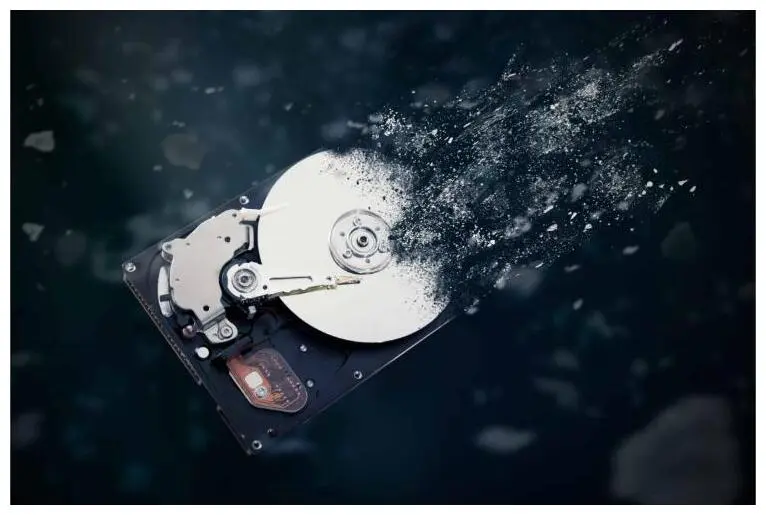
Physical destruction through shredding, crushing or disintegration reduces platters to particles. A modern hard drive platter stores data so densely that a fragment only a few millimeters across can still hold recoverable tracks, so particle size and process control matter for a defensible destruction claim.
HDD verdict: Effective. Maps to NIST 800-88 Destroy.
Step 3: Compare Effective And Ineffective SSD Methods
Five methods are commonly applied to SSDs. Three are effective and two are ineffective.
- ATA Secure Erase: A firmware-level command for SATA SSDs that instructs the controller to purge flash blocks. Some implementations of ATA Secure Erase only clear the mapping table rather than every flash block, so verification of the outcome is required rather than trusting a success return code. SSD verdict: Effective when supported and verified. Maps to NIST 800-88 Clear or Purge.
- NVMe Sanitize: The primary sanitize command for NVMe SSDs. NVMe Sanitize operates on the entire NAND, including the over-provisioned area. It offers crypto erase, block erase and overwrite modes. Block erase is the robust general mode. Sanitize is preferred over NVMe Format because it reaches the reserve. SSD verdict: Effective when supported and verified. Maps to NIST 800-88 Purge.
- Cryptographic Erase: This method destroys the media encryption key on a self-encrypting drive and renders ciphertext unrecoverable without touching flash cells. Cryptographic erase is valid when encryption was enabled from first use, the cipher is sound, the key is destroyed with no backup or escrow copy and the drive confirms the key was replaced. SSD verdict: Effective when encryption preconditions are met. Maps to NIST 800-88 Purge.
- Multi-pass overwriting: Multi-pass overwrite standards such as DoD 5220.22-M were designed to defeat magnetic remanence and map to NIST Clear rather than Purge. These methods cannot reach hidden cells on an SSD and each pass consumes limited flash endurance. SSD verdict: Ineffective. Does not reliably achieve NIST 800-88 Clear.
- Degaussing on SSDs: Degaussing does nothing to an SSD because flash cells hold a trapped electrical charge with no magnetic domain to disturb, leaving the data intact and readable. SSD verdict: Ineffective. No NIST 800-88 category achieved.
Step 4: Decide When Physical SSD Destruction Is Appropriate
Physical destruction of SSDs differs from physical destruction of HDDs. The NAND architecture creates specific failure modes that coarse methods cannot address.
Some SSD shredder blades create strips, and an SSD memory chip can survive this process intact. SSD NAND packages are smaller than the gaps in standard hard drive shredders, so chips can slip through a coarse shredder whole and still hold recoverable data. Drilling a single hole leaves large intact regions of flash that forensic tools can read.
An intact or partly intact NAND package can retain data even when the original SSD no longer works, and specialized laboratories may remove packages, access dies and read raw memory through direct NAND reading, controller and firmware analysis and logical translation reconstruction.
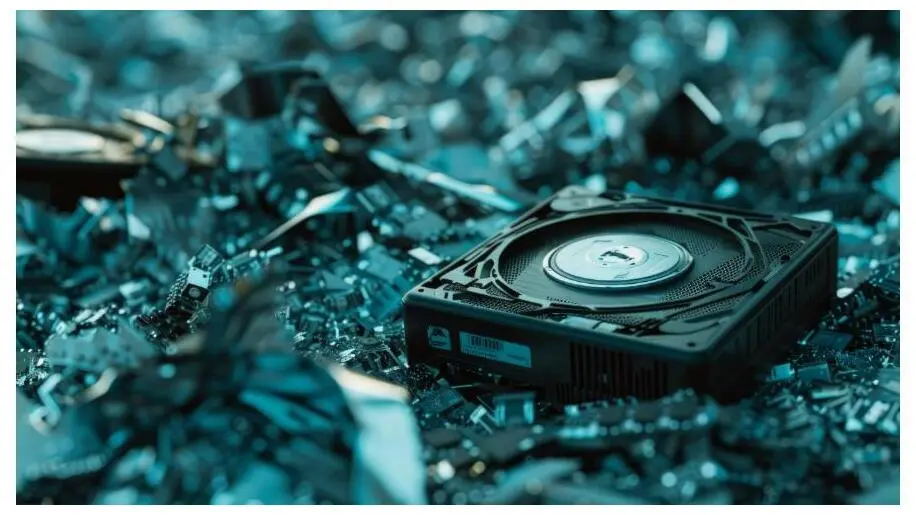
Effective physical destruction of SSDs requires particle reduction fine enough to fracture every NAND package. SSD destruction requires a shred that fractures every NAND package, with a finer particle size than the size used for magnetic hard drives. NVMe drives are small enough to pass through coarse HDD shredding lines and must be routed to flash-rated equipment.
Particle size matters most when a drive is headed for disposal. For drives returning to service, a verified firmware sanitize command is often the stronger path, which is the decision Step 5 addresses.
Step 5: Use A Reuse Versus Destroy Decision Path
Mixed fleets benefit from a structured decision path rather than a single method applied to every device. NIST SP 800-88 Rev. 2 states that a key sanitization decision is whether the media is planned for reuse and that purge sanitization techniques may be more appropriate than destroy techniques when reuse is planned.
Apply the following decision path by media type:
- Drive being reused, resold or redeployed: Use a NIST 800-88 Purge-level method appropriate to the media type. ATA Secure Erase or ATA Sanitize suits SATA SSDs. NVMe Sanitize suits NVMe drives. Cryptographic Erase suits self-encrypting drives. Verified overwrite suits HDDs. Confirm the outcome in every case.
- Drive leaving organizational control or holding regulated data (PHI, PII, ITAR-controlled information): Physical destruction is the safer default. A failed SSD that cannot process a sanitize command must be physically destroyed.
- Mixed and large fleet: Standardize by media type. Route SSDs and HDDs through separate, media-appropriate workflows.
Remote and satellite assets need a documented recovery workflow that maintains chain of custody from the point of collection through final disposition. Single drives and enterprise fleets often warrant different processes based on volume and data classification.
Plan a media-specific destruction workflow with full chain-of-custody documentation.
Step 6: Document Verification For Audits
Verification turns a device-level claim into evidence an auditor can evaluate. A drive that reports “sanitize complete” has made a claim, and documentation confirms that claim.
NIST SP 800-88 Rev. 2 introduces a formal distinction between verification and validation and requires both in sanitization programs. Verification confirms that a specific device was sanitized. Validation confirms that a sanitization method is effective for a class of media before approval for use.
A defensible audit package includes the following artifacts:
- Certificate of destruction or erasure: A model audit-ready certificate includes client legal name, unique certificate ID, linked chain-of-custody ID, media details by serial number, the action taken mapped to a NIST 800-88 category, the applicable standard, destruction date and location, operator name, verification result and final disposition outcome.
- Serialized audit report: Each serial number is matched to a documented method and verified outcome. A batch-level certificate that does not list individual serial numbers cannot be tied to specific assets during an audit.
- Chain-of-custody log: Every handoff is documented with custodian names, timestamps, container identifiers and tamper-evident seal status from pickup through final disposition.
Chain-of-custody documentation must be maintained at every transfer point, including intake, transport, staging, destruction and recycling-stream handoff, with each transfer carrying a signed, timestamped manifest naming the custodian, asset count and asset serial numbers.
The chosen NIST 800-88 level, Clear, Purge or Destroy, should match the data classification and regulatory requirement. HIPAA auditors expect a Business Associate Agreement executed before any ePHI-bearing devices leave the facility, serialized Certificates of Destruction with serial number, make and model, destruction method, date and operator, and chain-of-custody logs documenting every transfer from the client facility through final destruction. PCI DSS Requirement 9.4 governs cardholder-data media destruction and requires media be rendered unrecoverable when no longer needed.
How Full Circle Electronics Supports Secure Data Destruction
Full Circle Electronics aligns methods to NIST SP 800-88 Rev. 2 by media type and provides audit-ready certificates with a single unbroken chain of custody. With more than 20 years of experience in IT asset disposition, Full Circle Electronics serves organizations from SMBs to Fortune 1000 companies, government agencies and healthcare systems across the United States, Mexico and Colombia.
Key capabilities include:
- Certified processes: NIST 800-88 and DoD 5220.22-M compliant data destruction with methods matched to media type across mixed fleets.
- In-house destruction: Full Circle Electronics performs destruction in-house through certified facilities and maintains a single unbroken chain of custody from derack to final disposition.
- White-glove on-site service: On-site deracking, destacking and data destruction performed by background-checked professionals to limit operational disruption.
- Audit-ready documentation: Serialized certificates of destruction, chain-of-custody logs and real-time reporting available through a secure 24/7 customer portal.
- Reuse-first model: When destruction is not required, Full Circle Electronics evaluates assets for remarketing and value recovery to support circular-economy outcomes.
- Certification stack: e-Stewards, R2v3, NAID AAA, ISO 9001, ISO 14001 and ISO 45001 with compliance support for HIPAA, PCI DSS and ITAR.
- Geographic footprint: Certified facilities across multiple U.S. states plus operations in Mexico and Colombia for multi-site programs.
Request a quote for an audit-ready disposition program.